Introduction to This Stone Soup Writing Activity
“Once Upon a Time” is an example of a story written in unusual English. This work is by a six-year-old and is a good example of how young children express themselves differently from older children and adults. You will find lots of run-on sentences and dreamlike images flowing one into another. You will also see a lot of very short sentences, that are partly a sign that the author is very young, and partly a very effective method of story telling. You will see these techniques used by famous adult authors, as well as by some of the younger authors published in Stone Soup. It is also a useful practice for people working on poetry.
Project: Adopting a Style
For this project, create a narrator (the person who tells the story) who thinks in and speaks in an unusual English, in an unusual style. Think of a character—a infant, an older person, a visitor to your country whose first language is different, a person who is dreaming or confused for some reason, or someone living in an imaginary world of imaginary people and imaginary language. The fun of this project, and the challenge, is to find, invent and adopt the language of your character, use it to create your world and tell your story, and to make it understandable to your readers.
So, imagine you aren’t you, whether you are a different age, or from a different time or place or planet, and that you think and speak an English different from your own in structure and wording. Who and what do you see? How do you describe it? And what is the story you have to tell? If it helps you to tell the story, illustrate it too.
Once Upon a Time
By Robin Elder, 6, Hopewell, New Jersey
Illustrated by the author
From the March/April 1986 issue of Stone Soup
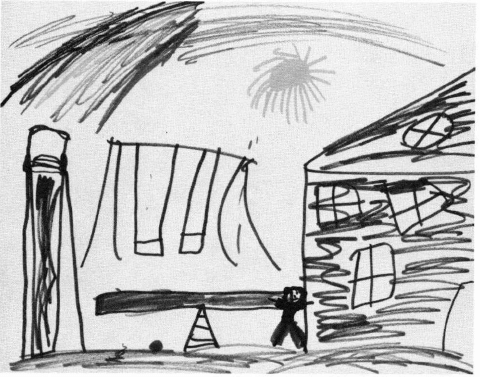
Once upon a time there was a little girl and a little boy. The little girl’s name was Judy. The little boy’s name was Michael. They lived in a old house. They played in the backyard. Their seesaw was made out of wood, their swingset was made out of wood, and their slide was made out of wood. They had a garden.
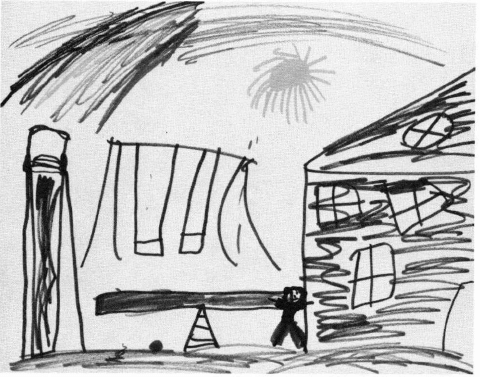 The little boy went out to play and when he swung on the swings he saw a rainbow. It was just after a rainstorm when he went out to play. He went to his sister and his sister went outside. They both looked up at the sky. They saw the rainbow. They got their mother and father and then they were all standing outside looking at the rainbow.
Then they heard a big boom. Their mother went into the kitchen, their father went into the bedroom, the little girl stayed outside, and the little boy went into the front yard. The mother found a broken window, the father found the faucet turned on, the little girl found the fence broken, and the little boy found an old man.
The little boy went into the house and called the police. He said, “Somebody robbed our house.” 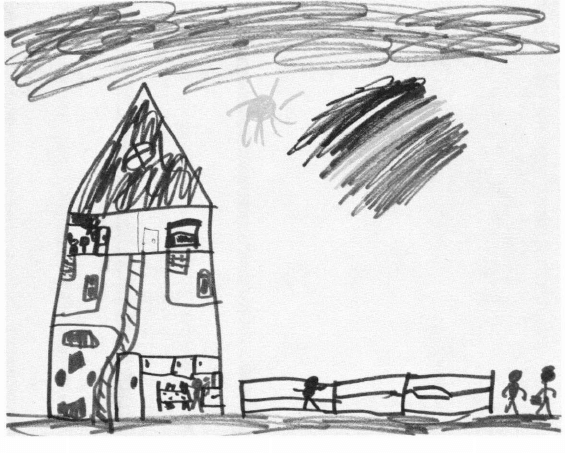
And the police came and said, “Did you rob their house?”
The old man said, “No, I am the plumber. I came to fix the sink. The fence got broken by the rain. The window got broken by the lightning. And they couldn’t turn off the sink, so I came just to fix the sink.”
So the policeman said, “Where’s the rain and where’s the lightning? I need to arrest them.”
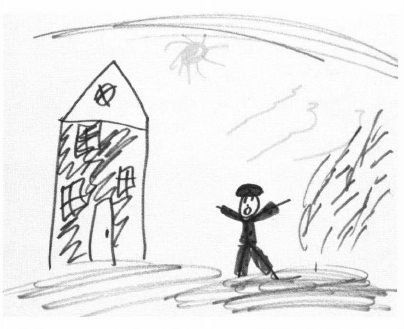 But then the rain came and the lightning and everyone was safe and sound in the house but the policeman. He stayed outside and tried to catch the rain and lightning. When the rain and lightning stopped, there were two pretty rainbows and then it happened over and over.
And then the little boy said, “Look at the rainbows.” Everybody looked. Everybody saw one rainbow for each of them. They all climbed their rainbows and slid down and around and around and around and around and around and around and around and around and around until somebody stopped and then somebody else and somebody else and else and else and else and else. And there was a rainbow monster and a rainbow dragon and a rainbow bunny and a rainbow deer.